Nintendo Switch 2 vs. Steam Deck OLED: Which Handheld Is Better for Modern AAA Games?
Only a few years ago, “AAA on a handheld” sounded like a compromise. Today players have two of the most talked-about devices in their hands: Nintendo Switch 2, launched on 5 June 2025, and Valve’s Steam Deck OLED. Both run Cyberpunk 2077 and both fit in a backpack, but their philosophies are fundamentally different.
Hardware: Nvidia and DLSS vs AMD and raw power
Switch 2 runs on a custom Nvidia chip (Tegra T239) with Ampere-architecture graphics, 12 GB of LPDDR5X memory and 256 GB of built-in storage. Its trump card is hardware DLSS support: the console renders at a lower resolution while tensor cores reconstruct detail. Docked, Switch 2 outputs up to 4K.
Steam Deck OLED uses an AMD APU with 4 Zen 2 cores and RDNA 2 graphics (8 compute units), 16 GB of LPDDR5-6400 and a 512 GB or 1 TB SSD. There is no hardware AI upscaling, but you get FSR and flexible manual tuning: frame limits, TDP and refresh rate.
| Spec | Nintendo Switch 2 | Steam Deck OLED |
|---|---|---|
| Screen | 7.9″ LCD, 1080p, up to 120 Hz, HDR | 7.4″ OLED, 1280×800, up to 90 Hz, HDR |
| Chip | Nvidia T239 (Ampere), DLSS | AMD Zen 2 + RDNA 2 |
| Memory | 12 GB LPDDR5X | 16 GB LPDDR5 |
| Storage | 256 GB + microSD Express | 512 GB / 1 TB + microSD |
| TV mode | Dock, up to 4K | Via USB-C dock, no AI upscaling |
| Launch price | $449.99 | $549 / $649 |
Screen and battery life
The screen is Steam Deck OLED’s strongest asset: deep blacks, vivid HDR and instant response make even older games look fresh. Switch 2 uses an LCD, but it is larger and 1080p, which matters for small text and dense AAA interfaces. Up to 120 Hz and VRR support in handheld mode are welcome extras too.
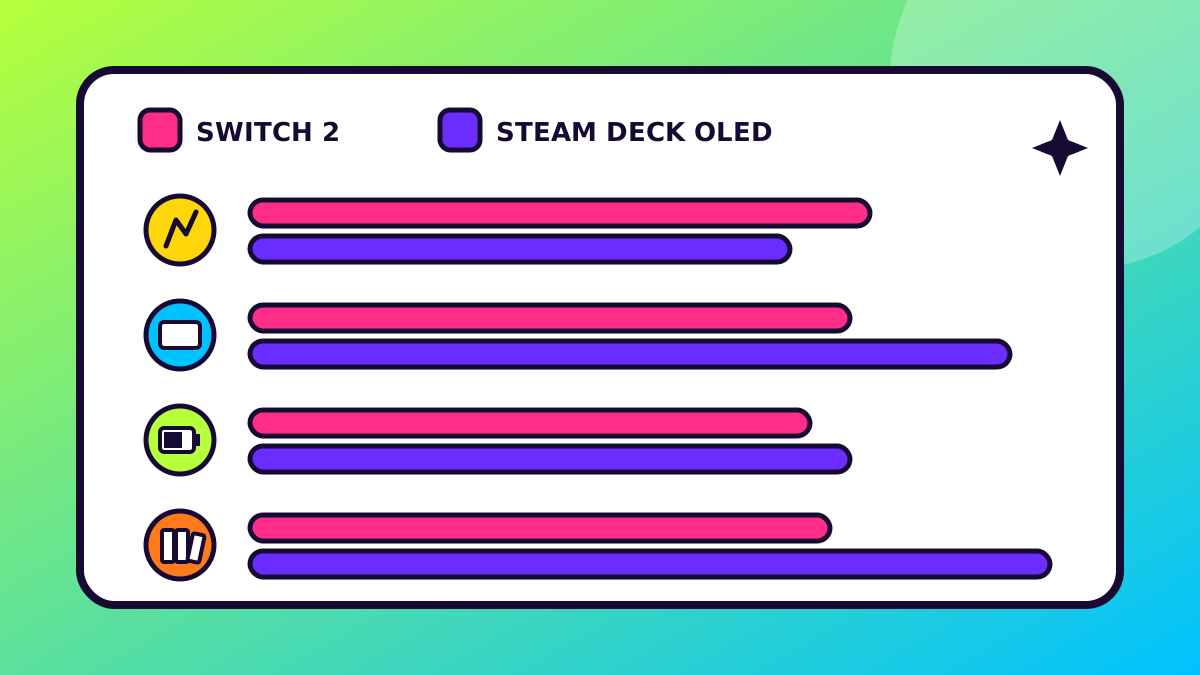
Both systems last roughly 2–6 hours depending on the game. Steam Deck OLED’s 50 Wh battery holds up slightly better in heavy titles, while on Switch 2 developers optimise power draw for one fixed hardware target.
AAA games: where do they run better?
Switch 2 has received full versions of Cyberpunk 2077: Ultimate Edition, Star Wars Outlaws, Hogwarts Legacy, Final Fantasy VII Remake Intergrade and other major titles. Thanks to DLSS and optimisation for a single hardware spec, the image on the 7.9-inch screen looks clean, and frame pacing is often steadier than PC versions on Steam Deck.
Steam Deck OLED wins on quantity: thousands of Steam games are rated “Verified” or “Playable”, including new releases that will never come to Switch 2. However, the most demanding 2025–2026 games have to run at 720p with FSR and low settings on Deck, and some titles with anti-cheat are not supported at all.
Ecosystem and game prices
Switch 2 is a closed ecosystem with Nintendo exclusives (Mario Kart World, Donkey Kong Bananza) and physical cartridges. Steam Deck is essentially a PC: your existing Steam library, frequent sales, mods, emulators and third-party launchers. If you already own hundreds of Steam games, Deck pays for itself faster.
Verdict
- Choose Switch 2 if you want plug-and-play simplicity, optimised AAA ports with DLSS, 4K TV mode and Nintendo exclusives.
- Choose Steam Deck OLED if you have a large Steam library and value the OLED screen, freedom to tweak and mods.
For modern AAA games in handheld mode, Switch 2 has a small technical edge thanks to DLSS. But Steam Deck OLED remains the most versatile pocket PC — and for many players, openness matters more than a few extra frames per second.